
A Brief History of Sport
Written by; Tao MacLeod
The history of sport is a vast and varied story. Games, activities and codes have been developed across a variety of different countries, regions and provinces, with each being able to tell us something about how they have evolved in that part of the world. Sport is primarily an act of leisure and healthy living, as well as a form of entertainment. It can also become an expression of various cultures and communities, thus allowing players, coaches and fans alike to engage with their recreational customs in a particular method of participation. Association football (known as footy, or soccer depending on where you live) is more popular in certain parts of the world compared to others. Additionally, the development of certain activities and codes can suggest something about a region, for example the evolution of rugby union and rugby league highlights the north-south divide in England and the class structure across Britain. Also, there are differences between rugby football, Australian rules football and American gridiron football. All of these have been developed on different continents, but have a shared history and basis in concept, which shows how a pastime (similar to a language) can develop in tangent to itself in different locations.
Sport can be quintessentially cultural. The way that activities, games and codes have developed in a particular location can say something about the society that produced it, as can the interactions between those throughout the class system, the opportunities for involvement of women, as well as the representation of ethnic minorities and members of LGBTQ+ communities. This article will take a glance at what the history of sport can tell us about our hobbies, our sources of entertainment and perhaps even why we might prefer one sport and even a particular style of play over another…

Early Origins, Beginnings and Variants of Sport from Across the World
In the early days sport was used as a method of physical training for the military, in order to prepare the population for war and other conflicts. Pursuits and events such as wrestling and archery, as well what we now think of as track and field activities such shot-put, running and javelin can be seen in the histories of countries as diverse as ancient Egypt, classical Greece and Rome and even medieval England. In particular archery was used as a method of overcoming other armies during hostilities between city and nation states. English monarchs have encouraged, at differing times, the training of shooting arrows towards target. The Robin Hood tales have a special resonance within England and with a focus on the English archer, of which we shall return to later.
Other more recreational versions of sports can be seen to have their origins in medieval England. In particular the type of footy that we see today has its genesis in a rougher version of the sport, latterly described as mob football played around seasonal festivals such as Lent and the associated Shrovetide. Elsewhere, similar ball and foot games were developed in Mediterranean Europe, as well as Asia. Episkyros was developed by the Ancient Greeks, but was probably more like modern day rugby, with a similar game developed by the Romans called Harpastum. Later on in Italian sporting history Calcio Storico Fiorentino was played during the middle ages, which was contested between two teams of 27 players. It was apparently a particularly violent game, with tactical head-butting, punching, elbowing and choking seemingly allowed. A somewhat less physical game came from China, in the form of Cuju or Ts’u-chü. This was a game played during the Han dynasty, that resembled football, volleyball, basketball and hacky-sack, where teams competed to aim to get a ball through a central hoop, without the use of their hands. They stayed on opposite sides of a pitch, with the target placed between them. All of these versions of football were played in parallel to each other before the more regulated codification of the sport during the Victorian and Edwardian periods of Britain in the late 18th and 19th centuries.

Over in Latin America pok-ta-pok, or pokolpok, was a popular game played in Mesoamerica. This was a region that was composed of the lands in North and Central America that included parts of Mexico, Belize, Guatemala, El Salvador, Honduras, Nicaragua and Costa Rica. The large scale and vast nature of the region meant that variations of the game were played in different citadels and municipalities, with evidence of variations being played in different communities and an evolution of the sport (becoming known as Ulama) coming out of the Aztec version of the sport in what is modern day Mexico. The specific rules of the game are no longer known, but archaeologists have found solid rubber balls dating back to this era, so we know that this was what the main bit of kit was made from. Balls varied in sizes, but weighed as much as 4.1kg, around about 9lbs. Apparently the most common theory is that players used their hips and other body parts to manoeuvre the ball around a rectangular stonemasonry based ball court. These courts varied in proportions between five metres wide to 16 metres in length to 30 metres by 96 metres in size. Stone rings were often seen placed approximately 6 metres, or roughly 20 feet above the ground at the mid-court point. These could have been a target, but due to the size (only slightly bigger than the ball) and height of position it could also have been a marker for teams to play around.
There have been several theories and suggestions around the cultural aspects of this sport. It was potentially a proxy for warfare and a method of diffusing, or sorting out conflicts between communities, citadels and ethnic groups. The sport is also thought to have had certain symbolic meanings around astronomy, war and spirituality (with the game being a meaning for a battle between life and the underworld). A reimagining of the game was shown in the feature length DreamWorks Animation movie The Road to El Dorado.
Capoeira is an Afro-Brazillian martial art that came out of the colonial era of South America, with origins in Africa and mixes dance with combat sport and spirituality. It was practiced by slaves in Portuguese controlled Brazil and was brought over by abducted peoples from Angola. Slaveowners not wanting these peoples to develop fighting skills, any sort of combat sport was banned. Capoeira, however, was developed to look like a type of dance. It involves (as it is still practiced to this day) a range of free flowing movements with a focus on a variety of different types of kicks, evasions, takedowns of opponents, handstands and acrobatics. A basic tenant of the activity is to distract and to deceive the opponent into thinking that you will be going one way and then to change direction and execute an alternative technique. Capoeira has been associated to both spiritual ritual and cultural art forms and is linked with the playing of music.
Lacrosse is one of the oldest leisure pursuits played in North America with evidence of the Native Americans playing a variation of the game as early the 12th century, across the continent, but predominately in what is now Canada, but also present day USA. It is amongst a category that is described as a lever sport, as participants use a stick to manipulate a ball to score in a targeted goal. Different tribes and communities had their own variations, but there was a commonality running through the different types. Lacrosse was played across vast areas, with teams ranging from hundreds to thousands of participants. Games could also last for several days, being played between daylight hours. People played for recreational reasons, but also had connotations around preparing young warriors for combat, as well as cultural and spiritual rituals. Gambling was also reportedly involved, with wagers being placed before games, with winning players gaining rewards for their victories. It was this that led to modern day game. The term lacrosse was given to the sport by French Jesuits who were the first Westerners to witness the sport, in the 17th century. Since then European settlers and migrants to North America have codified and further adapted the sport into its present incarnation. It remains one of the more popular games in the USA and Canada, more so than in other continents.
Going back to Asia we can see the sport of Kabaddi. This is a full contact sport that has its roots in the Vedic Age of India (c. 1500 – c. 500 BCE), spanning the late Bronze Age and early Iron Age periods of the history of the country. There are also, apparently, reports of the sport being played in Iran approximately 2,000 years ago and is also popular in modern day Bangladesh. The idea of the game is based around players from one team making raids into their opponents half of a court. An attacker is called a raider and looks to tag as many opponents and safely make it back to their own half without being tackled to the ground, with points are awarded for a successful attack, or defence during the course of play. Having first seen this on Indian television, whilst working in New Delhi, my initial impression was that it reminded me of playing British Bulldogs as a child in London during the 1990s. Modern day Kabaddi is seven-a-side and taken quite seriously across the South Asian region, however the International Kabbadi Federation (whose address is located in the Northern Indian city of Jaipur) has affiliated members from all over the world, including North and South America, Africa and Europe. The ethos of the sport is based around that of a bull escaping the grasp of those who would tame it, with acts of physical bravery are encouraged and applauded.

Beginnings of Organised Sports Across Britain
Archery is an activity that has its roots all over the world, with early evidence of bows and arrows having been found in South Africa and Northern Europe. The Olympic website claims that it was a sport favoured by the Egyptian pharaohs during the 18th dynasty (1567-1320 BC). Classical civilisations including the Greeks, Romans, Persians, Indians, Chinese and Japanese all kept archers in their armies. Initially developed as an act of violence it has since become a sport and is traditionally contested at the Summer Olympic Games. It was an activity favoured by British monarchs due to its military capabilities. Medieval peasants were encouraged to practice archery in case of the need to wage warfare. Often other sports were discouraged in order for ordinary working people to focus upon military practices such as archery. Specific to Britain the English and Welsh Longbow was considered to be an advanced piece of technology at the time and the aforementioned bow was particularly successful in the Battle of Crecy (26 August 1346) and Battle of Agincourt (25 October 1415) during the Hundred Years War.
The Robin Hood ballads are medieval stories that are set around the late 12th and early 13th centuries. They followed a gang of outlaws, led by Robin Hood, who lived in Sherwood Forrest and robbed from the rich to give to the poor in and around the Nottinghamshire, Lincolnshire and Yorkshire counties. In the early ballads he was a yeoman (this was a sort of ordinary person with certain rights, or lower middle class person – in medieval times a yeoman sat somewhere between the peasantry and the gentry). In later ballads he was depicted as a Nottinghamshire based nobleman, who had recently returned from the English-led Crusades. He is often depicted as a supporter of King Richard the Lionheart, as the younger royal brother Prince John looked to claim the throne.
This is relevant as Robin Hood is depicted as a skilled swordsman and archery, with the Yeomanry becoming known as competent archers by the 14th century. In one of the stories, Robin Hood and the Golden Arrow, the main character enters an archery competition. Both himself and his band of Merry Men disguised themselves in order to outwit the attempts to trap him by an ally of Prince John, the Sheriff of Nottingham. With the final shot Robin split the shaft of an opponent and then escaped the clutches of his enemies. This story indicates that even an act of military training was being pursued as a sporting contest during Medieval times.
As various types of firearms become the preferred tools for the military archery declined in popularity. Those with guns could provide greater firepower than those with bows and arrows. However attempts were made to revive the sport. Archery became fashionable amongst the British aristocracy in the 18th century, with societies and associations for the promotion of archery popping up across the country. Later attempts to revive the sport continued in the early to mid 19th century. The first Grand National Archery Meeting was held in York in the 1840s. The success of this led to greater involvement, with the Grand National Archery Society founded 1861, after a meeting at the Adelphi Hotel in Liverpool, thus becoming the national governing body for the sport in Britain. This society was rebranded in 2008 as Archery GB and still runs the sport across the country, delegating certain activities to smaller bodies in the Southern Counties, Northern Counties, East & West Midlands, Grand Western, Scotland, Wales and Northern Ireland. Today archery is still contested around the world. The first appearance at the Summer Olympics was at the Paris Games in 1900.
Golf and cricket were some of the earliest sports that gained great popularity across Britain. To this day these sports seem to be uniquely linked to these islands and British sporting culture. The playing of golf and cricket have perhaps been able to develop here due to the temperate climate and how this allows playing fields to be developed. Lush green fields suit the acts of playing and the roll of the ball in these games, which wouldn’t necessarily have been the case in other parts of the world.
The modern game of golf originated in Scotland. One of the earliest written records of the sport was that of it being banned by King James II of Scotland. This was an act of Scottish Parliament in 1457, which prohibited both golf and football. People had been playing golf in enclosed public spaces, when some thought that they should instead have been at work, church or military training, thus the game was deemed dangerous and a nuisance. King James II decided that the interference with the archery training of his army was too great and therefore stopped golf from being played by ordinary people. However, the ban was lifted several years later by his grandson James the IV. Another early written entry for the sport was in the minutes of an Edinburgh Town Council meeting, on the 19th of April 1592, where golf was mentioned in a list of pursuits to be avoided on the Sabbath.
One of the earliest known set of written instructions for golf came from an Edinburgh based medical student, called Thomas Kincaid (who lived between 1661 and 1726). He played at Bruntsfield Links, near Edinburgh University, and at Leith Links. His diary entries described a variety of golfing topics including how to take a golf stroke and set out opinions on an early handicap system. Bruntsfield Links is one of the oldest golf courses in the world, with the sport being played there as early as 1456. Adjacent to the existing fields is the oldest golf clubhouse of which we know. In 1717 the Golfhall was established, before being remodelled in 1898 by famous pub architect Robert Macfarlane Cameron. It is now known as the Golf Tavern and serves as a public house. Customers are able to rent golf clubs from this place and then make use of a free to use short hole golf course on Bruntsfield Links, before returning to the Tavern for a bit to eat and a drink.

Across Edinburgh is Leith Links, another location that was important in the development of golf in Scotland. The history of Leith itself is interesting, with it originally being a small 16th century town and port on the outskirts of Edinburgh, latterly becoming a burgh of the larger neighbouring city in 1920. Based on the shore of the Firth of Forth, it has developed a diverse culture where a variety of different peoples have come together as merchant ships have docked there, with gentrification happening more recently after it having been a working class area for years. Former Scotland international footballer Leigh Griffiths hails from Leith and went on to play for local team Hibernian FC. The club itself was set up by Irish immigrants living neighbourhood in 1875. The novel and latterly film adaptation of Trainspotting was based here as well.
Golf was played on the Leith Links with records showing a 5-hole golf course which that was typically played round twice. It has been said that both Charles I (of Scotland and England) and the future James VII (of Scotland) and II (of England) – both of the House of Stuart – played golf in Leith, whilst at the royal residence Holyrood Palace. These days Leith Links is still used well by the general public, with Leith Franklin Academicals Beige Cricket Club being formed as Leith Franklin in 1852. Leith Athletic Football Club (founded in 1887 and reformed in 1996) play their home games here as well. The Leith festival is held here each summer, continuing the community feel of the Links to the present day. Unfortunately for golf enthusiasts there is no longer a golf course based here, but there is a statue and a plague located in the area with a brief history of the significance the links has had to the sport. The importance of Leith to golf includes the first rules of golf, which were penned in 1744. They latterly became known as the Leith Rules, which became the basis on all further evolutions of the game.
However, the spiritual home of golf is across the Firth of Forth, in the county to the north of Edinburgh. St Andrews is a town in east of Fife, whose population in 2020 was a little over 18,000 and was named after Saint Andrew the Apostle. It has one of the oldest universities in the English speaking world, and the oldest in Scotland. The institution’s alumni include the founder of the Church of Scotland John Knox and former First Minister of Scotland Alex Salmond, as well as the Prince and Princess of Wales, and as of 2025 first in line to the British throne, William and Kate Windsor. The town also boasts the St Andrews Links, with its ten golf courses (the Old Course, Balgove Course, Jubilee Course, Strathyrum Course, the Castle Course, the New Course, Eden Course, the Torrance Course, the Kittocks Course and the Duke’s Course), The Royal and Ancient Golf Club of St Andrews and the St Andrews Golf Club. The latter private members club was founded in 1843, several centuries after the sport had begun on the Links, showing how popular the sport continued to grow after its inception.However, it was The Royal and Ancient Golf Club is significantly older, having been formed in 1754 and helped to further codify the rules of the game, helping to evolve the sport towards its modern incarnation. The Royal and Ancient Club has also organised several major and minor competitions, including The Open Championship (the main competition in Britain and the oldest in the world), the Amateur Championship (a prestigious amateur tournament and one of the four major championships before the professional game) and the St Andrews Trophy (a biennial competition contested between amateur teams from Great Britain and Ireland and continental Europe).
The Visit Scotland website (a government agency and national tourist board) describe the early days of golf in the town,
“Golf has been played on the Old Course in St Andrews for at least 500 years.
In 1552, a charter granted the townspeople of St Andrews use of the land for golf and other pastimes. However, it is thought that golf was played here for much longer than that.
In 1764, several holes were combined, reducing the number of holes played to 18, creating the standard model for golf courses around the world.
The only man to have won the Open Championship and the Amateur Championship at St Andrews is legendary golfer Bobby Jones. He was made an Honorary Burgess of St Andrews in 1958, only the second American to receive this honour, after Benjamin Franklin 200 years earlier.”
Cricket is probably a somewhat younger sport than golf, but one that still dates back several centuries. The earliest written record of the sport dates back to 1597, however there is a possibility that the 14th century term of Creag refers to an even earlier version of the sport. Early versions of the game were possibly played by Saxon, or Norman children in what is now England, with references of cricket being played by Englishmen dates back around the year 1611. By the mid-17th century village clubs and county teams had been formed, with a culture of organised sport being fostered. The sport had become cemented within the south-east of England and in particular the capital city of London. The laws of the game had been established in 1744 and then latterly amended in 1774. The members of the precursor to the Marylebone Cricket Club, at the time called the Star and Garter Club were significant in drawing up these codes and regulations, showing the importance of clubs would have as sporting culture developed across England and Britain.
In terms of equipment the bat became thicker and heavier compared to what was initially used. Additionally, protective gear became more prevalent as the game and its practices evolved over the years. The cup was introduced in 1874, whilst the helmet was first used around the 1970s. This was primarily due to the increase in the pace of the delivery of the ball from the bowlers and a greater understanding of the dangers of head injuries, but fundamentally it took approximately a century for men to realise that their head was as important as their genitals. It is now a sport that has travelled all around the world, particularly in former parts of the British Empire, including Australia, India and South Africa. However, cricket still seems to be quintessentially English. It seems to be linked to an ideal way of spending one’s leisure time, watching and playing games on the village green, or local park, drinking tea and enjoying English snacks like strawberries with cream. This is hardly representative of a modern and urban way of life across Britain, but is definitely something that is held up and clung to by some demographics who long for a simpler view of the past.

English Codification of Sport
In the Victorian and Edwardian periods of the 18th and nineteenth centuries a variety of sports saw massive changes to the way that they were run in England. Games and activities were organised in different ways, with alternative rules and customs across the country. When school teams and the emerging groups and clubs that were springing up across villages, towns and cities met up to play against each other they had to work out how to come together in order to get some sort of comprehensible game.
The people who wrote the rules tended to be the middle and upper middle classes within the south of England. The English tend to claim that they have invented a bunch of different sports, however, it’s probably more accurate to say that they codified these games, they wrote the rule books that became the basis for what we play in the modern era. As mentioned in the previous section cricket was developed by those who played it, however this sport is quite Anglo-Saxon. Other sports, whose origins emergence wasn’t necessarily as obviously or as wholly from one location can show how the regulations were coalesced by the professional, white collar types in the urban London area.
In terms of football, on 26 October 1863, the Football Association was formed at the Freemasons’ Tavern in Great Queen Street, London. The clubs represented at this first meeting were Barnes, War Office (who became Civil Service FC and still turn out an amateur side), Crusaders, Forest (Leytonstone), No Names (Kilburn), Crystal Palace (apparently, no relation to the modern day side), Blackheath, Kensington School, Perceval House (Blackheath), Surbiton, Blackheath Proprietory School and Charterhouse. It was here that a set of rules for playing the game were created for the first time, thus making a break from the sport we now know of as rugby. Previously the two sports had been developed in parallel with each other, with disagreements amongst those who played the games about how physical a contest should be.

The emergence of what became initially known as rugby football is thought to be based around three specific events. Firstly, an initial set of rules were written up in 1845, secondly the breakaway of the Blackheath Club from the Football Association in 1863 and, thirdly, the formation of the Rugby Football Union in 1871. The ethos of this sport has been based around an increased level of physicality that distinguishes it from that of association football. Heavier tackles have been a mainstay of rugby that promote physical bravery.
As rugby football evolved there were discussions around the role of amateurism within the game. Most of those who played and administered the sport were from middle and upper class backgrounds. The powers that be frowned upon payments being made by the clubs to those who play, thinking instead that people should play for the love of the game. Many others disagreed, especially those from working class backgrounds who would lose a half, or full days work in order to turn out for their local club. Ideological debates got so heated that a schism happened. Those who wanted to open the sport up to commercial and financial opportunities created a new code called rugby league. This became most popular within the industrial north of England and the mining communities of Wales. The preexisting code became better known as Rugby Union.

The original schism happened in the late 19th century, with the first Rugby League game being played in Huddersfield in 1895. However, it was the success of northern clubs that allowed them to compensate players with financial payments. It was this act that put the code at odds with the amateur principles within British sport. This was focused around several tenants including, in this instance, playing rugby as a leisure time activity and non-monetary participation, allowing for health and social interaction based benefits. In addition to this the amateur ideals looked to promote intrinsic values within players such as sportsmanship and fair play, as well as a rejection of professional practices such as professional coaching, strategies and tactics for winning and professional fouling outwith the spirit of the game.
The concepts around and against professionalism in sport I find particularly interesting as the amateur ideologues tended to be from the upper middle and upper classes within the Victorian and Edwardian colonial eras, whose mindset at the time was that talent could and should be intrinsic. Therefore training towards improvements, with fiscal rewards was the act of a tradesman and against the value systems of just being better than somebody else. It could also be said that these people wanted to maintain control of the administration of sport instead of collaborating with those who came from working class backgrounds, bringing aspects of classism into the debate. This didn’t go down well within industrial parts of the country, where those who worked for a living and didn’t have shares and dividends that could make money work for them. The taking time off from work for leisure activities, before the implementation of the weekend (hard fought for by the trades unions) would have a negative effect on the income of a working class household.
On the 29th of August 1895, a meeting at the George Hotel in Huddersfield created a different code of rugby that allowed players to take money for missing work in order to play matches. Rugby League grew over the intervening years going overseas. Several different countries have professional teams, Australia, New Zealand (who both refer to the sport as football, or footy), England, Samoa and Tonga. The inaugural Rugby League World Cup was hosted in France in 1954, with Great Britain taking the gold medal. The Aussies have since won the most world titles. In terms of historical diversity and inclusion the first ever captain of a British sports team occurred when Clive Sullivan skippered the Great Britain rugby league side in 1972. Under his captaincy GB won the 1972 World Cup, beating France in the Final.
The Movement of British Sport Overseas
The British military was one of the main purveyors of the British culture of sport around the world. The introduction of sports such as field hockey, cricket and rugby has had long lasting affects on the sporting landscapes of a variety of countries across the former Empire (now known as the Commonwealth) including India, Pakistan, Australia and New Zealand. Strangely enough football, the most famous of English exports, hasn’t been traditionally strong in these countries, although this seems to be changing for reasons to do with globalisation. Colonialism, however, did have an effect on the games that were played in the various parts of control by the UK. The soldiers were encouraged to play sports in order to stay active, healthy and in good condition. This was integrated into local communities, especially with those who were involved in the British military. The legendary Indian hockey player Dhyan Chand learnt the sport whilst being a professional solder for the British Indian Army, rising to the rank of Major after independence. The International Cricket Council describes the expansion of their sport on their website,
“Cricket was introduced to North America via the English colonies as early as the 17th century, and in the 18th century it arrived in other parts of the globe. It was introduced to the West Indies by colonists and to India by British East India Company mariners. It arrived in Australia almost as soon as colonisation began in 1788 and the sport reached New Zealand and South Africa in the early years of the 19th century.”
However, this wasn’t the only method of the spreading of sport around the world. The quote above alludes to the idea of businesses, or at least those who traveled abroad for work, spreading British sporting culture overseas as well. The East India Company unfurled its tentacles far and wide, in fact acting as a form of colonist in lieu of the British government in places such as India. However, other companies and organisations set out looking for financial success in other geographical locations as well. Rugby and hockey is particularly popular in Argentina, as well as football across the wider Spanish speaking regions of Latin America. This was, in part, due to economic trade across the Americas. Merchant seaman from Europe were stepping off the ships in South American ports and playing pick up games of footy, which attracted the attention of the locals. Also, diplomats and captains of capitalism would set up private members clubs across the cities of the continent and developed the sport that way. Whilst coaching football in Mexico City in 2018 I came across more than one sports club that was set up by British and Irish immigrants. Reforma Athletic Club was set up in 1894 by English migrants, so that those far away from home, could still play sport and socialise with each other. The club still exists today and puts forward a variety of activities, including football, cricket and tennis. Similarly, across town there was another venue that my company put on sessions at Club Irlandes de Raqueta, that was set up by Irish migrants, with a particular focus on racquet sports.
This stemmed from the industrial revolution that was happening in Britain, approximately between the years 1750 and 1900. This prompted a major change in industry and the national economy which saw an increase in the middle classes, as those who invested in the new technologies of the era found financial success. These industrialists had more money and greater amounts of leisure time to do with as they wanted. By the latter parts of the Victorian era and beginning of the Edwardian period, roughly speaking the late nineteenth and early twentieth centuries, they began to invest their dosh elsewhere in the world. Britain already had lands in North America, such as the Caribbean and Canada, as well as links with the English speaking USA. However, a military excursion in Latin America would have meant a significant drop in diplomatic relations with the Spanish and Portuguese, as well as a distinct change in foreign policy. This is where capitalism stepped up in order to further British interests overseas. In addition to the businesses that were brought over to places such as Mexico, Argentina, Uruguay and Brazil (all of whom have coastal ports, on the Atlantic Ocean, with direct merchant lines to Europe), they brought with them the sports learnt whilst studying at British schools and universities. Rugby, cricket, hockey, tennis and football were all promoted at these educational institutions where the newly minted capitalist classes would have sent their children and perhaps have gone themselves. The emerging rules and regulations of the various codes developed in these places and further evolved at British sports clubs have travelled across the seven seas to new shores.

Early Versions of Organised Sport Across North America
Baseball is one of the earliest played sports in North America that has its beginnings on the continent in the mid-19th century. However, its initial origins came from European games such as rounders and stoolball that were spawned in the British and Irish Isles. Stoolball was a game played in the Tudor period (the time spent on the English throne by the House of Tudor 1485 to 1603) as early as the year 1500, probably by milkmaids who used their milking stool as a wicket and their milk bowl as a tool to hit a ball with. This activity possibly inspired games such as rounders, cricket softball and baseball.
Similarly, rounders is a game also played as during the Tudor period, with an early mention of the game being made in a children’s book called A Little Pretty Pocket-Book in 1744, where it was referred to as ‘base-ball’. It involves two teams alternate between batting and fielding. Those with a bat look to hit a ball thrown by a fielder and then run around a series of bases in order to score points known as rounders, without being put out by the fielders. The first nation-wide set of formalised rules was created Ireland, by the Gaelic Athletic Association (GAA) in 1884. This prompted a series of associations to be created across England and Scotland over the next few years. The sport seems to have even travelled across the Atlantic Ocean to the USA in the 19th century, and inspired what the Americans now call baseball.
American football, or gridiron football, has its origins in the sport of rugby football, which was brought over by the British in the late 1800s. Both Rugby Union and Rugby League is more free flowing than American Football, however the code of Rugby League comparisons particularly with gridiron codes. Rugby League and gridiron have a limited number of tackles, or downs (an attempt by the attacking team to carry the ball forward, without being stopped by the opposition), as well as a preference shown towards the scoring of tries, or touchdowns over the kicking for points from goals. However in rugby a player isn’t allowed to pass the ball forward, instead looking to force the object of focus forward through physical strength and teamwork. Additionally, the Americans also do tend to prefer a greater amount of padding and other types of protective equipment than the sport that came out of Britain.
However, both American and Canadian versions of football do seem to have evolved from the earlier code of rugby football, that the British had brought over to Canada in the 19th century. Rugby became popular in the schools and universities across North America. Similar to the early codification of sport in England around about the same time and several years earlier, further modifications to the games played in academic institutions were made when games were competed against each other. Codes were developed in parallel to what was happening back in the British Isles, creating sports that was preferred by those who played and watched the games in North America.
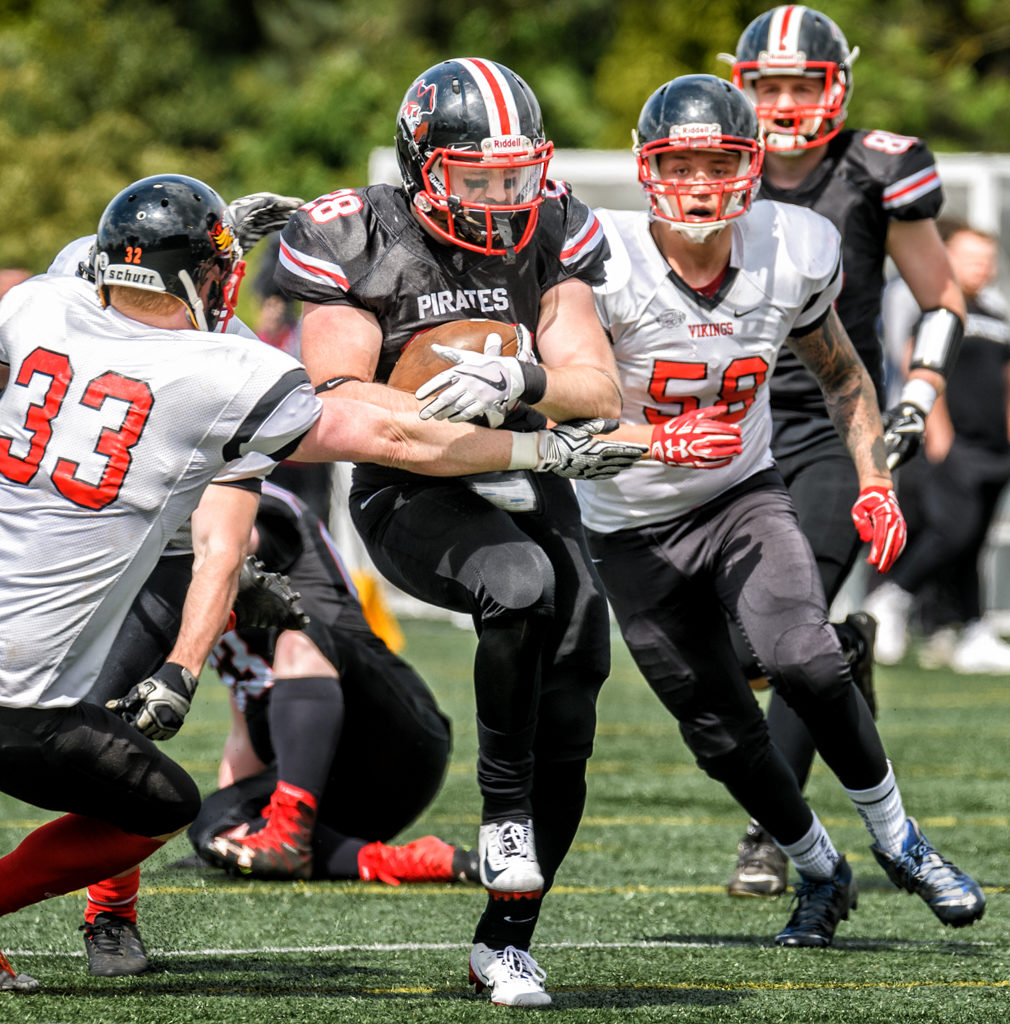
Canadian football was first played in November 1861, at the University College, University of Toronto, involving students of the academic establishment. The rules were still in flux at this time, with, a club was formed shortly after this game was played. The first written account of a game played was on October 15, 1862 on the Montreal Cricket Grounds, with the match was played between teams made up by the First Battalion Grenadier Guards and the Second Battalion Scots Fusilier Guards. The sport gained popularity with clubs being formed in Hamilton, Montreal and Ottawa, as well as the teams that were developed in Toronto. The modern version is 12-a-side, and is played on a pitch that is 110 yards (101 metres) long and 65 yards (59 metres) wide, where players look to attack, or invade the oppositions end zone and/or goalposts. A maximum of three downs is allowed. The goalposts are positioned at the back of the end zones.
American football, is rather better known than its Canadian cousin. The layout of the pitch is similar, being 100 yards (91.44 m) long between the goal lines, and 160 feet (48.8 metres, or 53.3 yards) wide. However, the goalposts are at the front of the end zones, instead of at the back as done so in Canada. The Americans also have four downs to carry the ball forward towards the oppositions end zone. It is also played with 11 players on the pitch, instead of 12. It is generally considered that the first game was played between two college teams, Rutgers and Princeton on November 6, 1869. At the time the rules had still to be developed to what is played in the modern era, with the game being played as 25-a-side. The ball was shaped spherically and could not be picked up or carried, but could be kicked or batted with the feet, hands, head, or sides. Rutgers were recorded to have won the game 6–4.
It became popular amongst colleges and universities, with representatives of Yale, Columbia, Princeton and Rutgers meeting on October 19, 1873, in order to create a standard set of rules for use by all schools. However concern about the violence of the sport prompted President Theodore Roosevelt to threaten to abolish the game, unless changes were made. This led to a series of discussions that eventually created the Intercollegiate Athletic Association of the United States, now known as the National Collegiate Athletic Association (NCAA). The National Football League (NFL) was established in 1920 and was set up to regulate the professionalism of players and teams. It has since become one of the largest sporting brands in the world, with franchise teams such as the New England Patriots, San Francisco 49ers, Dallas Cowboys and New York Giants becoming known the world over.
Australia and Aussie Rules Football
The loosely regulated and ill-defined versions of what would later become football and rugby had been taken over to Australia, by the colonists and settlers who arrived on those shores in the early part of the 19th century. Similarly to how various sports had developed by in England, the early versions of football had been taken up by the private schools as a method of promoting physical strength and so-called ‘manly’ attributes. The Aussie rules footy teams began to spring out of cricket clubs that had already established itself as a sport in the New World. The origins of the game are mixed by several codes including association football, Gaelic football, rugby football, as well as several competing codes including Sheffield rules, Cambridge rules Winchester College football and Harrow football.
Aussie rules football started to create its own set of rules, codifying itself more formally from around 1859. This set of regulations allowed the sport to become more popular, with clubs being set up in Melbourne FC (1859) Geelong (1859), Carlton (1864), North Melbourne (aka Hotham) (pre-1869), Port Adelaide (1870), Essendon (1872), St Kilda (1873), South Melbourne (now Sydney Swans) (1874), and Footscray (now the Western Bulldogs) (1877), who are all still playing in the modern era. In addition to this leagues being set up in states such as South Australia and Victoria in 1877. Eventually a unified, nation-wide organisation was founded that took control of the sport. Formerly named the Victorian Football League, the Australian Football League was formed in 1990 expanding its leagues and competitions to other states across the country.
The game in the modern era is 18-a-side, with four substitutes allowed to be interchanged at any time. It is played on a cricket oval due to its heritage and historical links to cricket in Australia. Six points are scored by kicking the ball through a set of goalposts, similar to that seen in rugby and American football, with two additional outer and shorter posts positioned either side of the main target, where shots scored are worth one point. Players are allowed to handle the ball with a clenched fist and passing with the hands, as well as kicking with the foot, similar to Gaelic football. There is also a set of rules akin to its Irish sporting cousin around positional field marking, when a player caches the ball cleanly he or she gains an advantage over an opponent, in terms of being allowed to then kick the ball freely without interference. Physicality on a par with rugby and Gaelic football is allowed and actively encouraged. Aussie rules football is yet another example of a seemingly unique sport, linked with a specific culture within a patch of a globe that has drawn upon inspiration from other codes, activities and games that grew from others parts of the world.

Differing Codes of Hockey – Field Hockey and Ice Hockey
Two separate codes of hockey have developed in different parts of the world seemingly in isolation to each other. Field hockey was developed in the south of England in the mid to late 19th century, partially by players at Blackheath Rugby Club, but primarily by cricket players, with those involved at Teddington Cricket Club providing the initial basis for the modern rules of the game. The English and British fashion for amateur clubs and sporting associations helped drive this sport forward over the years, with several evolutions occurring up to the present day. It is a stick and ball game that was initially set up in a similar way to association football. The initial intention was for it to be played as an alternative sport to footy during the autumn and winter months of the sporting calendar and was taken up, in particular, by private schools and universities. The game became played predominately by the middle and upper classes who frequented these establishments.
This class aspect during the Victorian and Edwardian eras allowed women to participate in greater numbers than other sports, such as football which had begun to become popular within the industrial north of England. This class and gender prevalence has now become somewhat of a stereotype for field hockey, with many of those who don’t play describe it as an activity for posh girls from the English public school system. It is now played at a variety of levels, throughout the world. The British army exported the sport across the former empire, with particular popularity of the pastime being shown in India, Pakistan, Australia and New Zealand. It was introduced into the Summer Olympics at the London Games of 1908.
Although field hockey has had some participation within the British Commonwealth across North America, as well as other neighbouring countries like the USA it hasn’t taken off in the same respect as elsewhere. With Canada being closer to the Artic Circle than the United Kingdom and the associated environmental factors that come with such a geographical location meant that the same sports wouldn’t necessarily become as popular after being transported across the Atlantic Ocean. Ice hockey is a game that came out of Canada, in particular the French speaking city of Montreal, Quebec, in the late 19th century. There are reports of matches were played from around about 1875.

Ice Hockey is another invasion game that involved players on two separate teams that looks to score in the opposition goal. It took inspiration from similar sports that already existed at the time, such as field hockey, popular North American game lacrosse, as well as Gaelic sports hurling from Ireland and shinty which originated in Scotland. As the name indicates this form of hockey came from the cold conditions of the frozen north. Instead of a spherical ball, six players use sticks to manipulate a puck across the ice, whilst using skates to scoot themselves across the glacial surface. Initially this was a flat circular piece of wood, but is now made of rubber. It includes a variety of attributes including physical strength, power and grace, as well as high levels of cognition and hand-to-eye coordination. Players need to be able to execute intricate skills, at pace, whilst under large amounts of physical pressure from toothless Canadians, thus making it one of the most full-bodied all-round spectacles in sport. From its initial beginnings the game has spread to other parts of the world, including the USA, Russia and Scandinavian countries with Sweden in particular doing well within international competitions. Ice hockey was included in the inaugural Winter Olympics in 1924, hosted Chamonix, France. It was won by Canada, who beat their American neighbours in the final.

Olympic Games and Olympic Sports
The modern Olympic movement was the labour of love for French aristocrat Baron Pierre de Coubertin. Born in Paris in 1863, he travelled to England as a young adult and fell in love with the Tom Brown’s sporting stories, about a fictional character who is a school boy at the private Rugby School and then a student at Oxford University. Here he learnt about life and developed several social and physical attributes, such as leadership, toughness and resilience through his sporting experiences at these academic institutions. De Coubertin also took inspiration from the actual headmaster of Rugby School of the time, Thomas Arnold, who was fictionalised in the book Tom Brown’s School Days, written by Thomas Hughes. What the French Baron took from these variety of people called Thomas was a sense of how sport can improve the lives of people, not only through the act of physical improvements in health, but as a tool for education and personal growth. De Coubertin particularly admired was the sense of fair play and morality that the English upper class establishment liked to think that they espoused through their educational system at institutions like Rugby.
As mentioned in previous paragraphs the English upper and middle classes of the late 19th and early 20th centuries were also very keen on the amateurish ideals of sport. Those who had the money to have plenty of leisure time were able to participate in any particular sport, simply for the pure enjoyment of such an act. To play for the love of the game was central to this philosophy and as these privately educated people ended up in positions of authority in the governing bodies of most sports they then forced this on others who played, including those who actually worked for a living and struggled to afford as much leisure time as those like Pierre de Coubertin. However, this didn’t stop the Frenchman taking inspiration from this ethos that he had come across on his travels around Britain in the 1880s and merging it with what he had learnt about the ancient Olympics in Greece. De Coubertin then spent a large part of his adult life starting up the modern Olympic Games.
The ancient Olympics were held in what is now Greece, with the first festival being held in 776 BCE. However, at the time Greece wasn’t a unified country that we know it to be today, but a series of city states and regions that were periodically allied with some and at war with others. There was a religious element to the games, with sacrifices and processions happening to honour the father of the gods Zeus. This is what eventually did the original Olympics as they were seen to be a pagan festival by the Roman Emperor Theodosius I, abolishing the games in 393 CE. The festival itself started out as a one day event, before being extended to three days and then five days. Sports included running, long jump, shot put, discus, javelin, boxing, equestrian events and pankration (a primitive form of martial arts). Glancing my eye across these activities they mostly seem to based around combat training. How to hit and hurt others with objects such as shot puts and javelin, how to use horses to gain an advantage, how to fight each other and how to run faster than an opponent all seems to be to have militaristic tendencies, but it was all done in a rather more peaceful manner than actual combat. Athletes became famous and were much celebrated for success.
These games are what inspired Pierre de Coubertin to recreate a sporting festival in the late 19th and early 20th centuries. There has been much debate over how accurate was the French Baron’s interpretation of the ancient Games. As mentioned above he viewed amateurism as the ideal for sporting participation and he seemed to approach his historical research into the Olympics with some degree of prejudice, as athletes in the olden days did seem to receive some sort of financial reward at different times in the festival’s history. De Coubertin’s amateurish ideals also held that the simple act of participation was more important to the Ancient Greek athletes than winning, that the love of the game would overwhelm personal ambition, however, this doesn’t seem to hold true. As is human nature sometimes dictates it would appear that we have seemingly always enjoyed being treated like a celebrity. As we see today, the competitors of the time also liked having a fuss made over them and the importance of the Olympic Games would have put winners on a literal and metaphorical pedestal.

The modern Olympic Games begun in 1896, with the Greek capital city of Athens being the first hosts. Events included athletics, cycling, fencing, gymnastics, shooting, swimming, tennis, weightlifting and wrestling, showing similarities to the sports in the ancient games, but with more of a focus on general physical prowess, instead of specifically combative expertise. This festival continued over a four year cycle, occurring in the summer months in a different city each time. London and Paris have, at the time of writing, hosted the most Summer Olympic Games, with three apiece, whilst Athens and Tokyo have also held two apiece. As the years went by other sports have been added to the great sporting spectacle. Hockey, rugby 7’s, football and 3×3 basketball are the best known representatives of invasion sports. Surfing, rock climbing and volleyball are also now included as sporting events. Other individual pursuits include cycling, swimming, tennis and golf, making this a feast of sporting entertainment, with something for everybody. The Summer Olympics is now only matched with the FIFA World Cup in terms of prestige in terms of the global public imagination.
In 1924 the Olympic movement expanded to included winter sports. Similar to the Summer Games, the Winter Olympics is on a four year cycle, more recently tailored to come two years before and after its warmer alternative. Activities such as alpine skiing, biathlon, cross-country skiing and ski mountaineering are all activities that seem necessary to survive in cold climates such as those seen in Scandinavia and others based around the Artic circle. Other sports now include ski jumping, bobsleigh, curling, figure skating and ice hockey all add variety to the spectacle.
The differences in the sports seen in the Summer and Winter Olympics are interesting in what they represent in terms of cultural significance and climatic conditions within certain regions. Some countries dominate codes and games in the Winter Olympics, particularly those from Scandinavia like Finland, Norway and Sweden. They do particularly well in sports that they get easy access to due to their icy and snowy surroundings as opposed to those seen in the Summer Olympics, where the sports are perhaps better suited to different weather and geographical conditions. However, other nations with large land masses and big populations, such as the USA, Canada and Russia tend to finish high up on the medal tables in throughout the four year Olympiad due to their diverse climates across their countries and strength in depth in terms of athletic talent pool. Fundamentally, the two different Olympic Games show a diverse range of ways that sportsmen and women can adapt to different physical and environmental surroundings.
Final Thoughts
A variety of different sports have been played all over the world, with similarities being seen in an abundance of different cultures. The British had a profound affect on the development and evolution of sports in the late 19th and early to mid 20th centuries, but this isn’t indicative of a particular element of genius with regards leisure activities, but instead that they were a global super power at the time and the upper and middle classes had a lot of time on their hands. Variations of the sports that were preferred by the English, Scottish, Welsh and Irish have been seen elsewhere in the world both before and after codifications of games such as rugby and football, but others have added to what they learnt and often enough gone in their own direction, as seen in North America and Australia. Fundamentally these show that humans are pluralistic by nature, we enjoy creating variety and adapting to the geographical and environmental conditions that we find ourselves in. In addition to this we enjoy physical activity and, on occasion, we show a competitive spirt. To overcome obstacles and to strive to be better is something that we can all enjoy.

