Sports People in Profile; Jim Thorpe
Written by; Tao MacLeod
In the early decades of the twentieth century of the USA there was a sports star who competed at high levels across track and field, American football, baseball and basketball. He won Olympic gold medals in the pentathlon and decathlon events, became one of the early trailblazers in the National Football League (NFL) and is now seen as an icon within certain communities in North America. He also played for well known teams in his various sports including the New York Giants and the Cincinnati Reds. Yet, I bet many people reading this profile have never come across his name before…
James Francis Thorpe, better known as Jim, was born in May 1887, in the state of Oklahoma. A member of the Sac and Fox Nation he was the first Native American to win a gold medal for the US Olympic team. As an ethnic minority in the USA, during a time of heightened racism within the country, he would have encountered overt discrimination from an early age. However, his sporting talent overcame a variety of obstacles including the prejudices of the era and poverty allowed him to achieve something in life that has eluded many others. He played football on the gridiron pitch at college, having attended the Carlisle Indian Industrial School, in Pennsylvania. Here he took several All-American accolades, as well as becoming a national champion in 1911. He also showed promise in athletics whilst at Carlisle winning several events between 1908 and 1912.
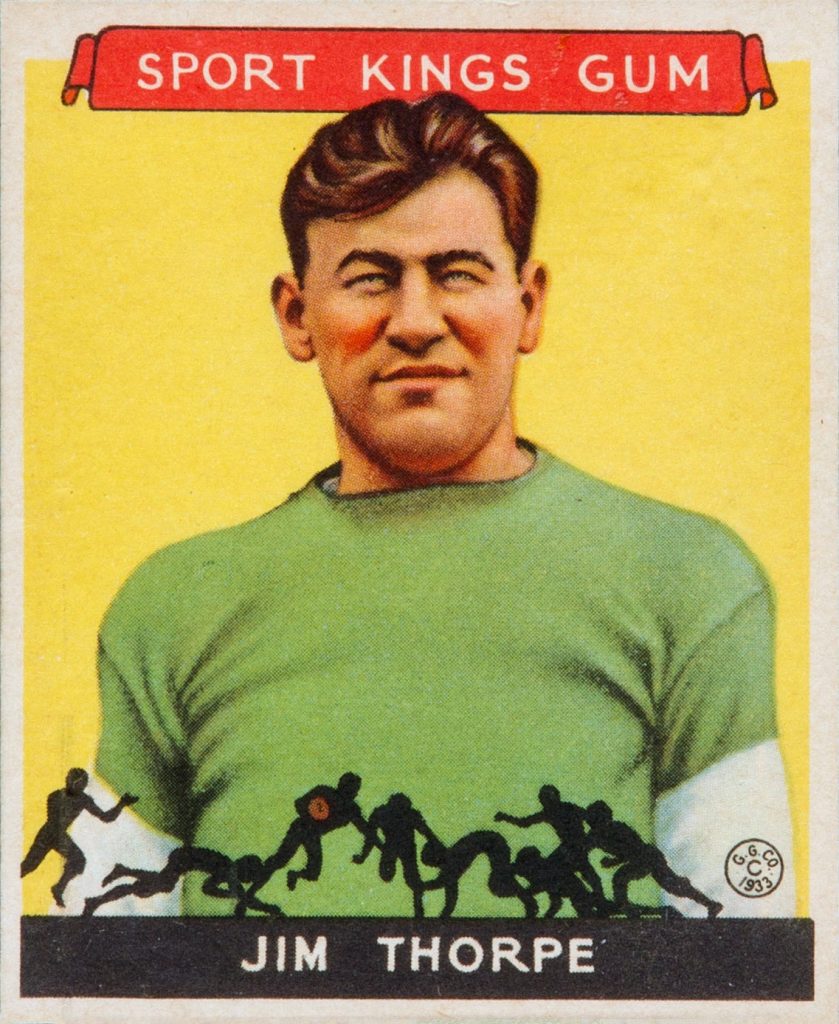
Thorpe’s football career went on for several years, as both a player and a coach. He in fact carried on playing until the age of 41, long after he had been acting as a member of the coaching set up for his teams. Having started out with the Pine Village Villagers in 1915, the longest time he spent with a team in a journeyman career was with the Ohio based Canton Bulldogs, for whom he was also the head coach. He also acted as player coach for the Oorang Indians. This was travelling team made up entirely of Native Americans and played in the National Football League (NFL) in 1922 and 1923. In 1925 he also spent time playing for the New York Giants. Jim finished up his playing career with the Tampa Cardinals in 1928. He never played for an NFL Championship team, but did win several awards and accolades, including being a First-Team All-Pro in 1923, as well as being included in the NFL 1920s All-Decade Team as a halfback and the NFL 50th Anniversary All-Time Team. In total he played 52 games in the NFL, scoring four field goals and six touchdowns, with a total points tally of 51.
His baseball career also reached the Major League level. Playing as an outfielder he threw and batted as a right hander. Thorpe played for three teams between 1913 and 1919, spending the most time with the New York Giants baseball franchise, with whom he had three stints. He also turned out for the aforementioned Cincinnati Reds and finished up with the Boston Braves. He had a batting average of .252 and scored seven home runs. Little was known of Jim’s basketball career, until documentation was found in 2005. In 1926 his sporting celebrity seems to have been able to attract fans to a stadium. This appears to have prompted him to become the main feature of the World Famous Indians. This was an exhibition team that toured the USA, playing different opponents in order to earn money. As he was coming towards the end of his playing career Jim Thorpe might have seen this as a nice little earner before his retirement.

However, It was his track and field career that provided the most success. Having done well in the national trials, Thorpe made the US Olympic track and field team that went to the 1912 Summer Games in Stockholm. Here he won two gold medals in the pentathlon and decathlon events. However controversy ensured after his victories. The International Olympic Committee (IOC) found out that he had previously spent two seasons playing professional baseball. This not only went against the amateur ideals of the era, but the rules and regulations of Olympic participation. Even though the sport which he was paid to participate in was different to that in which he won his medals in Sweden, the fact that he took payment at all riled the upper class administrators of the IOC. Regulations were strict in this respect. Those who took prize money for success in tournaments and even those who worked as sports teachers were considered professionals and therefore less than those who participated as amateurs.
This was effectively a part of the battle of wills between those who could afford to take time off from work to play games and those who needed to supplement their income somehow. Jim Thorpe was one of those in the latter group. As a Native American his vocational and professional opportunities in the early decades of the 20th century would have been limited. Sport offered him a route for socio-economic advancement. Nevertheless, this wasn’t a consideration for the likes of Baron de Coubertin and Avery Brundage, who were strongly averse idea of professionalism in sport. It wasn’t until 1983, 30 years after his death, that Thorpe’s family received replicas of his medals as part of the reinstatement of his wins and records.
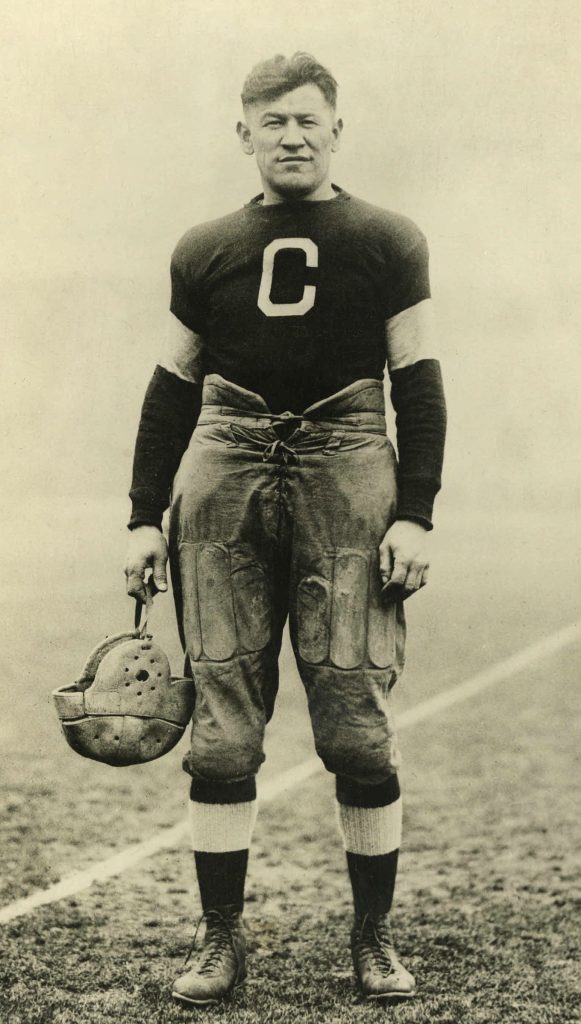
Over the years Thorpe encountered racism and prejudice. The various first nation peoples across North America have been subjected to forced resettlement away from their ancestral lands, as well as one sided government treaties. They were only granted full US citizenship in 1924 and were subjected to the segregation laws that also affected African Americans in the Deep South. It had been suggested at the time and since that Jim’s ethnicity may have been a reason why he was stripped of his Olympic titles, with American officials rebuffing attempts to have his medals reinstated for decades. Jim’s daughter, Grace Frances Thorpe, actually became an activist for Native American rights, as well as an environmentalist. His retirement from professional sport coincided with the Great Depression and Thorpe struggled financially in his later years. Unfortunately he also battled with alcoholism. He was married three times and had eight children. With his health ailing he died in March of 1953, aged 65. He leaves behind him a legacy that should be remembered by more people. Surely, he should be considered one of the great North American all round athletes, of the 20th century. It is the opinion of this writer that Jim Thorpe should be regarded amongst the pantheon of sporting legends.