
Sports People in Profile; Bill Richmond
Written by; Tao MacLeod
The sport of boxing has a little known pugilist from within its past that dazzled the rings of Britain. Before the days of Chris Eubank, Lennox Lewis, Franks Bruno, Nicola Adams and Anthony Joshua there was another who reached the top of his game. This fighter overcame many hurdles, having been born into slavery, before moving country to become a celebrated sportsman. However, many sports fans and enthusiasts won’t know who he is and that needs to change. In this profile piece we will take a look at the life and times of Bill Richmond…
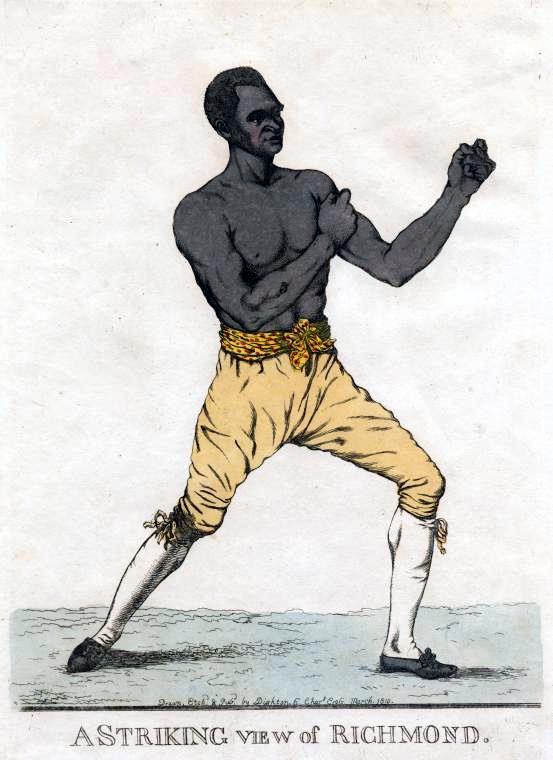
Born in August 1763 in the city of New York, that was at the time in British controlled America. Bill Richmond’s parents were African-American slaves in the overseas colony. Subsequently, upon his birth he was also considered the property of another man, the Reverend Richard Charlton. The hypocrisy of a religious person owning another human isn’t something that can be easily understood these days. However movements for the abolition of slavery started to make headway in the latter half of the 18th and early part of the 19th centuries. Advancements were made in Britain with a legal precedent being set in the 1770s, outlawing slavery on the island. However this wasn’t transferred to the rest of the empire, where the slave trade was proving a profitable economy for many big businesses and members of the establishment. It wasn’t until 1807, with the passing of the Slave Trade Act, where the buying and selling of human beings became illegal in Britain. Additionally it wasn’t until 1833 that the Slavery Abolition Act was passed that ended slavery across most of the British held colonies, which only came into force in 1834.

In 1776, during the American War of Independence, British soldiers were stationed in the same town as Bill Richmond. Here he caught the attention of Lieutenant-General Hugh Percy, the second Duke of Northumberland, after the teenaged Bill was involved in a bar brawl with some British servicemen. Lord Percy got to know the young brawler and arranged for his release from slavery. He subsequently arranged for the newly freed man to travel to England and paid for his education. Richmond went on to become an apprentice cabinet maker in Yorkshire. In 1791 he married a local woman called Mary Dunwick, with whom he had several children. He often faced racism in his adoptive country. A literate and self confident man, he was not one to be ridiculed, or disrespected. On one occasion he stood up to a racist who insulted him for having a white wife, with the situation coming to blows. By 1795 Richmond had moved to London to join the household staff of the Royal Navy officer, Thomas Pitt, the second Baron Camelford. This wasn’t as a slave, but as an employee. It was around this time that he got started in organised boxing.

His new employer, Thomas Pitt, was an enthusiast of boxing and introduced Bill Richmond to the sport, taking him to several different bouts. Soon enough he entered the ring himself. In the early 1800s he had noteworthy contests against George Maddox and Tom Cribb, in which he is said to have demonstrated skill and bravery. In total he had 19 fights, winning 17 of them, losing only two, as a welterweight. By the end of his career he had become one of Britain’s top pugilists. After retiring as an active fighter Richmond became a trainer. He would help amateur boxers and even guided literary figures, including William Hazlitt, Lord Byron, and American John Neal in their training. Bill twice put on exhibitions for European royalty who had visited England. His celebrity even earned him a position as an usher at the coronation of King George IV in 1821. For this he received letters of thanks from politicians Lord Gwydyr and the Home Secretary Lord Sidmouth. This was a phenomenal journey from having been a slave in colonial America, to being a part of a royal ceremony. He died in London in December 1829, aged 66. Bill Richmond deserves to have his name remembered more widely.

One Reply to “Sports People in Profile; Bill Richmond”
Comments are closed.